What Stoic Week is (and where this plan fits)
This seven-day Stoic Week plan for parents and 12–16-year-olds is built on the Three Laws from Dimitrios Tsakmakis's series All the Knowledge I Want to Bestow Upon My Children: two days on control, two on doing what is right rather than easy, one on protecting without taking, one on clear thinking, and one to look back. Each day is one 10–15-minute practice the parent does too.
Stoic Week is an annual, free, online event run by Modern Stoicism that invites people to “live like a Stoic for a week”. The 2026 theme is “Stoicism and Wellbeing”. The adult course has seven chapters, one for each day of the week, and Modern Stoicism says it is intended for people aged 18 or over.
For teenagers, Modern Stoicism publishes Stoic Week for Schools: a free handbook and instructor's guide, available all year. It is designed for classroom teachers, parents can also use it with their children at home, and the suggested ages are 13-15. It is a good resource, and well worth a look.
Modern Stoicism's Stoic Week for Schools is a free five-day classroom course, Monday to Friday, with suggested ages 13–15, which parents can adapt at home. The Three Laws plan is written for the kitchen table instead: seven days, ages 12–16, with the parent doing every practice alongside the teenager.
This plan is independent; it is not part of Modern Stoicism's course.
The seven days
Dates are for Stoic Week 2026. Any other week, Day 1 is a Monday.
Day 1 (Mon 26 Oct): Up to me, or not up to me? — Law I
Day 1 of Stoic Week at home: for one day, every time you feel upset, ask “Is this up to me, or not up to me?” and write down five examples. The practice comes from Law I, “Know what is in your control and what is not”, in Chapter 2 of Foundation.
The practice (Foundation, Chapter 2, “What I Want You to Do”, the Law 1 exercise): for one day, every time you feel upset about something, ask “Is this up to me, or not up to me?” Write down five examples. See how many of your worries are about things you cannot control.
“Anger at things you cannot control is like shouting at the rain. The rain does not hear you, and you only lose your voice.” (Foundation, Chapter 2)
Parent’s part: Do the same and share one of your five first.
Dinner-table question: “Which of today's five did you get angry about that wasn't up to you?”
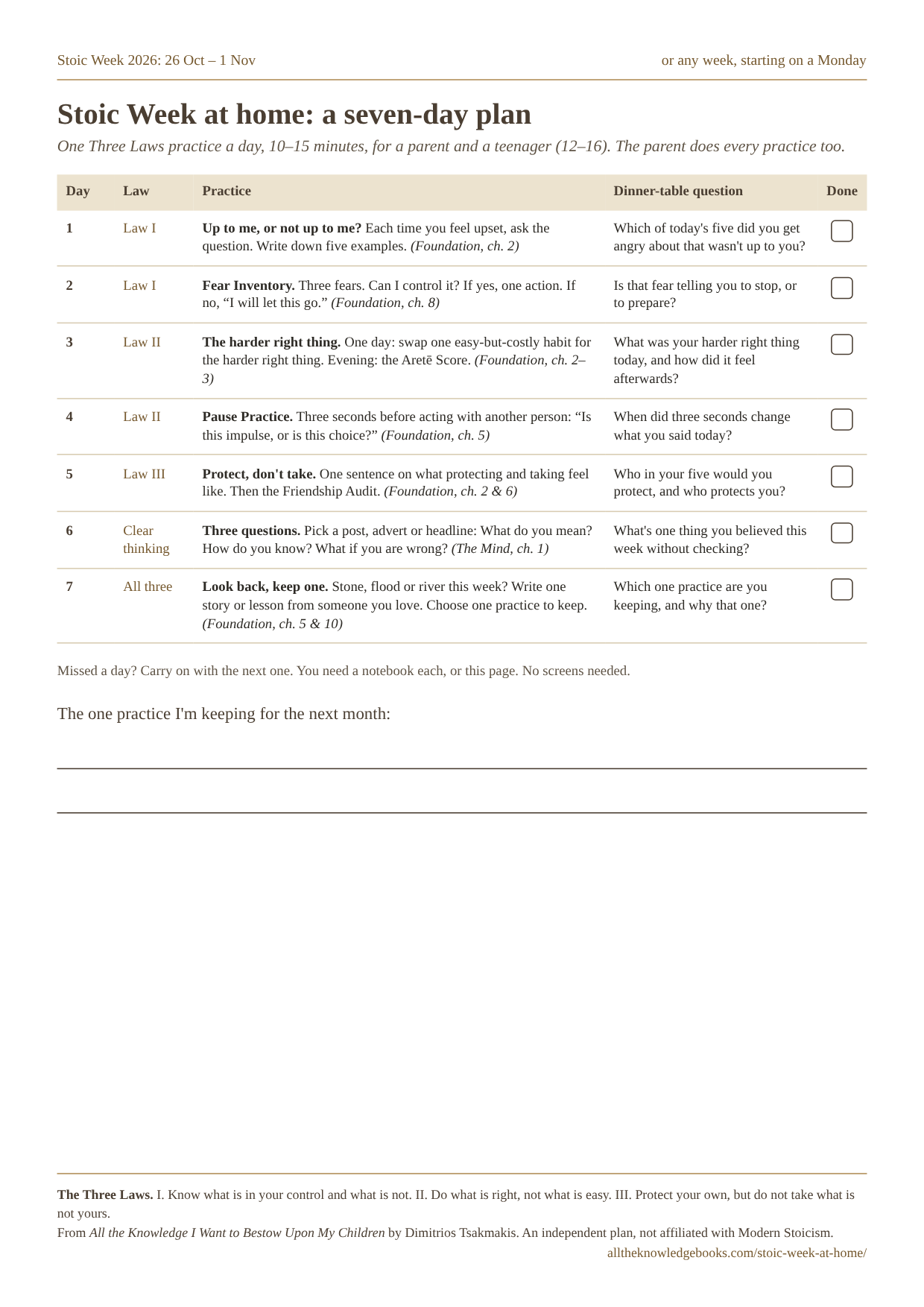
Law I on the Three Laws page · Foundation (Volume I)
Day 2 (Tue 27 Oct): What is fear telling you? — Law I
The practice (Foundation, Chapter 8 “Fear and What It Means”, the Fear Inventory): write down three things you are afraid of right now. Next to each, write whether the fear is about something you can control or something you cannot. If you can, write one action you will take. If you cannot, write “I will let this go.”
Optional, same chapter: the Physiological Sigh Practice. Before something that makes you nervous: a deep inhale, a shorter second inhale, then a long, slow exhale.
Parent’s part: Share one real, age-appropriate fear of your own and what you did about it.
Dinner-table question: “Is that fear telling you to stop, or to prepare?”
Law I · more exercises in Foundation
Day 3 (Wed 28 Oct): The harder right thing — Law II
The practice (Foundation, Chapter 2, the Law 2 exercise): pick one thing you do because it is easy but know makes your future harder, and for one day do the harder right thing instead. Notice how you feel afterwards, not during.
In the evening (Foundation, Chapter 3 “What Is Good?”, the Aretē Score): “Did I do what I was capable of today? Did I practice anything hard? Did I avoid any easy wrong thing?” One point for each yes. As the book says, the goal is awareness, not perfection.
“The easy path is usually a debt you pay later, with interest.”
Parent’s part: Choose your own “easy wrong thing” (the phone at dinner works) and report back honestly.
Dinner-table question: “What was your harder right thing today, and how did it feel afterwards?”
Law II · Foundation (Volume I)
Day 4 (Thu 29 Oct): Three seconds between impulse and choice — Law II
The practice (Foundation, Chapter 5 “What Is Wise?”, the Pause Practice): for one day, before any action that involves another person, pause for three seconds and ask “Is this impulse, or is this choice?” Write down one moment when the pause changed what you did.
Optional, same chapter: the Want vs. Need Test. When you want something badly (a snack, a purchase, a reply), wait one hour and see whether the want changes.
“Do not ask: ‘Does this feel good now?’ Feelings lie. Ask instead: ‘Will this make my future easier or harder?’” (Foundation, Chapter 2)
Parent’s part: Use the Pause Practice at the moments you usually snap: mornings, homework, the school run.
Dinner-table question: “When did three seconds change what you said today?”
Law II · more exercises in Foundation
Day 5 (Fri 30 Oct): Protect your own, take nothing that isn’t yours — Law III
The practice (Foundation, Chapter 2, the Law 3 exercise): think of a time you could have taken something and chose not to, or did take it and felt wrong afterwards. Write one sentence about what protecting feels like in your body, and what taking feels like.
Add-on (Foundation, Chapter 6 “Choosing Your People”, the Friendship Audit): list the five people you spend the most time with and mark each friendship as pleasure, utility or virtue, Aristotle's three kinds, as the chapter explains. In the book's words, “Choosing your people is part of protecting your own.”
“There is a difference between strength and theft.”
Parent’s part: Do your own audit (keep it private if you need to) and share one virtue friend.
Dinner-table question: “Who in your five would you protect, and who protects you?”
Law III · Foundation (Volume I)
Day 6 (Sat 31 Oct): Three questions before you believe it — The Mind (Volume II)
The practice (The Mind, Chapter 1 “The Examined Life”, from the practice section “How to Practice the Examined Life”): three questions, “What do you mean? How do you know? What if you are wrong?” Weekend version: parent and teenager each pick one post, advert or headline from the week and run the three questions on it together.
Parent’s part: Run the questions on one of your own strong opinions too: “How do I know this is true?” (the book's weekly version).
Dinner-table question: “What's one thing you believed this week that you got from someone else without checking?”
The Mind (Volume II) · how the laws work together
Day 7 (Sun 1 Nov): Look back, keep one, pass one on — all three laws
The practice (Foundation, Chapter 5, the Stone-Flood-River Check): at the end of the day ask, “Was I stone (too rigid), flood (too impulsive) or river (directed, feeling, but governed) this week?” Write one sentence without judging yourself.
Then (Foundation, Chapter 10 “Loss and What Remains”, the Memory Preservation exercise): each of you picks someone you love who is still alive and writes down one story they have told you, or one lesson they taught you. Writing down what you know so it isn't lost is what this whole series is.
Close the week: each person chooses one practice to keep for the next month and writes it at the bottom of the printable plan. Want to write your own letter? Here is an 18th-birthday letter guide.
Parent’s part: Go first on all three, and read your story aloud if you're willing.
Dinner-table question: “Which one practice are you keeping, and why that one?”
the full series (this week used a handful of practices; Foundation has dozens more) · why Dimitrios Tsakmakis wrote it
Questions parents ask
When is Stoic Week 2026?
Stoic Week 2026 runs from Monday 26 October to Sunday 1 November 2026. It is a free, online event run by Modern Stoicism; you register for the adult course on its website, learn.modernstoicism.com.
What is the theme of Stoic Week 2026?
Modern Stoicism's course page gives the 2026 theme as 'Stoicism and Wellbeing'.
Is Stoic Week free? Do I need tickets?
Stoic Week is free and there are no tickets. You register online for Modern Stoicism's adult course. This at-home plan needs no registration at all: read it here or print the one-page plan.
Can teenagers do Stoic Week?
Modern Stoicism's main Stoic Week course is intended for people aged 18 or over and points younger people to Stoic Week for Students. Its Stoic Week for Schools materials are free to download, designed for classrooms and adaptable at home. This seven-day Three Laws plan is another option for parents and 12–16-year-olds.
What is Stoic Week for Schools?
Stoic Week for Schools is Modern Stoicism's version of Stoic Week for school-age students: a free downloadable handbook and instructor's guide, available all year. It is designed for classroom teachers, parents can also use it at home, and the suggested ages are 13-15.
Is this plan part of Modern Stoicism's Stoic Week?
No. It is an independent at-home plan by the author of All the Knowledge I Want to Bestow Upon My Children, timed to the same week.
What age is this plan for?
It is written for 12–16-year-olds doing it with a parent, daughters and sons alike. That matches the 12+ guidance for the books the practices come from.
Can we do it after Stoic Week?
Yes. The plan works any week. Start on a Monday, follow the seven days in order and keep the one-page plan on the fridge.
What if my teenager won't join in?
Do the practices yourself, out loud, at the table. Keep it to ten minutes, share your own answer first and invite rather than insist. If a day is missed, carry on with the next one.
Which book goes with the plan?
Foundation, Volume I, for days 1 to 5 and day 7, and The Mind, Volume II, for day 6. Foundation has dozens more exercises like these.
More questions about the books →