What are the four Stoic virtues?
They are often called the four cardinal virtues, from the Latin cardo, “hinge”: the other virtues were said to hinge on them. Plato names wisdom, courage, self-control and justice in Book IV of the Republic as the virtues of a good city and a good person. The Stoics kept the set. Diogenes Laertius, summarising Stoic teaching, writes: “The following are the primary: wisdom, courage, justice, temperance” (Lives of the Eminent Philosophers VII.92, tr. R. D. Hicks). Every other virtue was grouped under these four (see the Stanford Encyclopedia of Philosophy, “Stoicism”).
Marcus Aurelius reached for the same list. In the Casaubon translation of the Meditations (Project Gutenberg, numbered III.VII there, 3.6 in modern editions): “If thou shalt find anything in this mortal life better than righteousness, than truth, temperance, fortitude…”
The Stoics held that virtue is the only true good, and that the four belong together: you can't really have one without the others.
The books don't hand teens a list of four. They teach the Three Laws and three Greek words (aretē, andreia, sōphrosynē), and the four virtues live inside them.
To explain the four Stoic virtues to a 12–16-year-old, use one real situation for each: a bad mark (wisdom: what's up to you?), trying out for a team (courage), a friend's screenshot in the group chat (justice), and one more video at midnight (self-control). Then ask one question, and answer it yourself first.
Wisdom (phronēsis): knowing what is up to you and judging what to do
Wisdom, for the Stoics, is practical: judging what to do in a real situation. The Mind (Volume II, Chapter 5) defines phronēsis as “the ability to judge what to do in a real situation, with real stakes and imperfect information. Not cleverness. Not book learning. Judgment.”
Law it lives in: Law I, “Know what is in your control and what is not.” Wisdom starts by sorting what is up to you from what is not.
At school: a bad mark comes back on a test. The mark is already given, and the teacher's mood isn't up to you. What you study next time, and whether you ask what went wrong, are.
Practice: the Law 1 exercise in Foundation, Chapter 2: whenever you feel upset, ask “Is this up to me, or not up to me?” Or use the three questions from the practice section of The Mind, Chapter 1: “What do you mean? How do you know? What if you are wrong?”
Dinner-table question: “What's one thing you worried about this week that wasn't up to you?”
Courage (andreia): doing the right thing while you are scared
Courage is not feeling no fear. It is doing what is right while afraid. Foundation (Chapter 4, “What Is Strong?”) describes andreia as “Excellence in the face of danger. Not danger for its own sake. Danger in service of what matters.”
Law it lives in: Law II, “Do what is right, not what is easy.” The harder right thing usually needs courage.
In sport or class: trying out for a team you might not make, speaking up in class, or telling the coach you were the one who broke the rule.
Practice: the Small Courage Practice from the same chapter: “Do one small thing every day that scares you slightly. Speak up in class when you normally stay quiet. Try a sport you are not good at.” And when something feels brave, the Recklessness Check: “Am I doing this to help someone, or to prove something about myself?”
Too little, too much: too little courage is cowardice; too much is recklessness. As the book puts it, “Courage serves others. Recklessness serves the ego.”
Dinner-table question: “What's one small brave thing you did, or didn't do, this week?”
Justice (dikaiosynē): being fair and not taking what isn't yours
Justice is fairness and honesty: doing right by other people, including people who can't do anything for you. It is the opposite of taking what isn't yours.
Law it lives in: Law III, “Protect your own, but do not take what is not yours.” In the book's words, “There is a difference between strength and theft.” Foundation's own examples of taking are small and everyday: “a toy, a turn, credit for work someone else did”.
On the phone: a screenshot of a friend's private message starts going round the group chat. Forwarding it is taking: their trust isn't yours to pass on. Protecting is not passing it on, and perhaps telling the friend.
Practice: the Law 3 test from Foundation, Chapter 2: “Am I protecting, or am I taking?”
“The test is not whether you will be caught. The test is whether you will still recognize yourself afterward.” (Foundation, Chapter 2)
Dinner-table question: “Did anyone take something from someone else this week (a turn, credit, a secret)? What would protecting have looked like?”
Self-control (sōphrosynē): a river, not a flood or a stone
Self-control, often called temperance, is governing what you feel and want, not switching feelings off. Foundation (Chapter 5, “What Is Wise?”) gives the Greek word sōphrosynē (“so-fro-SOO-nay”) and says plainly: “Sōphrosynē is not suppression. It is direction.”
Foundation uses “wise” in the older sense of sōphrosynē: soundness of mind. On this page, “wisdom” means practical wisdom (phronēsis), as in most writing on the Stoics.
Law it lives in: Laws II and III together. Foundation ties it to Law III: “Courage without self-control becomes violence. Self-control without courage becomes weakness.”
On the phone: it's 11 pm and one more video starts playing. Or an angry reply is half-typed.
Practice: the Pause Practice (pause for three seconds and ask “Is this impulse, or is this choice?”), the Want vs. Need Test (if you just want it, try waiting one hour) and the Stone-Flood-River Check, all from Foundation, Chapter 5. Day 4 of the Stoic Week plan is built on the Pause Practice.
In Foundation, self-control (sōphrosynē) sits between two failures: stone, too rigid to feel, and flood, ruled by every impulse. The goal is a river: “directed, feeling, but governed.” Teens can check themselves at the end of a day: was I stone, flood or river?
Dinner-table question: “Were you stone, flood or river today?”
Stoic Week plan, Day 4 · Foundation (Volume I) · Teen anger: a guide for parents
How the four virtues fit the Three Laws
The Three Laws at the heart of Dimitrios Tsakmakis's series are: I. Know what is in your control and what is not. II. Do what is right, not what is easy. III. Protect your own, but do not take what is not yours.
| Law | Virtues it needs |
|---|---|
| I. Know what is in your control and what is not. | Wisdom |
| II. Do what is right, not what is easy. | Courage, self-control |
| III. Protect your own, but do not take what is not yours. | Justice, held in balance by courage and self-control |
This mapping is our reading, not a claim from the ancient sources. The Three Laws are the author's own code, drawing on the Stoics. Law I echoes the opening line of Epictetus's Enchiridion: “Some things are within our power, while others are not.”
A week of virtues (Stoic Week tie-in)
Stoic Week 2026 runs Monday 26 October to Sunday 1 November. Our free seven-day Stoic Week plan for parents and teens uses the same practices: Day 1 is Law I, Day 4 is the Pause Practice, Day 5 is Law III. This page and the plan are independent; they are not part of Modern Stoicism's course.
Teachers: Modern Stoicism publishes a free classroom course, Stoic Week for Schools.
The four virtues on one card (printable)
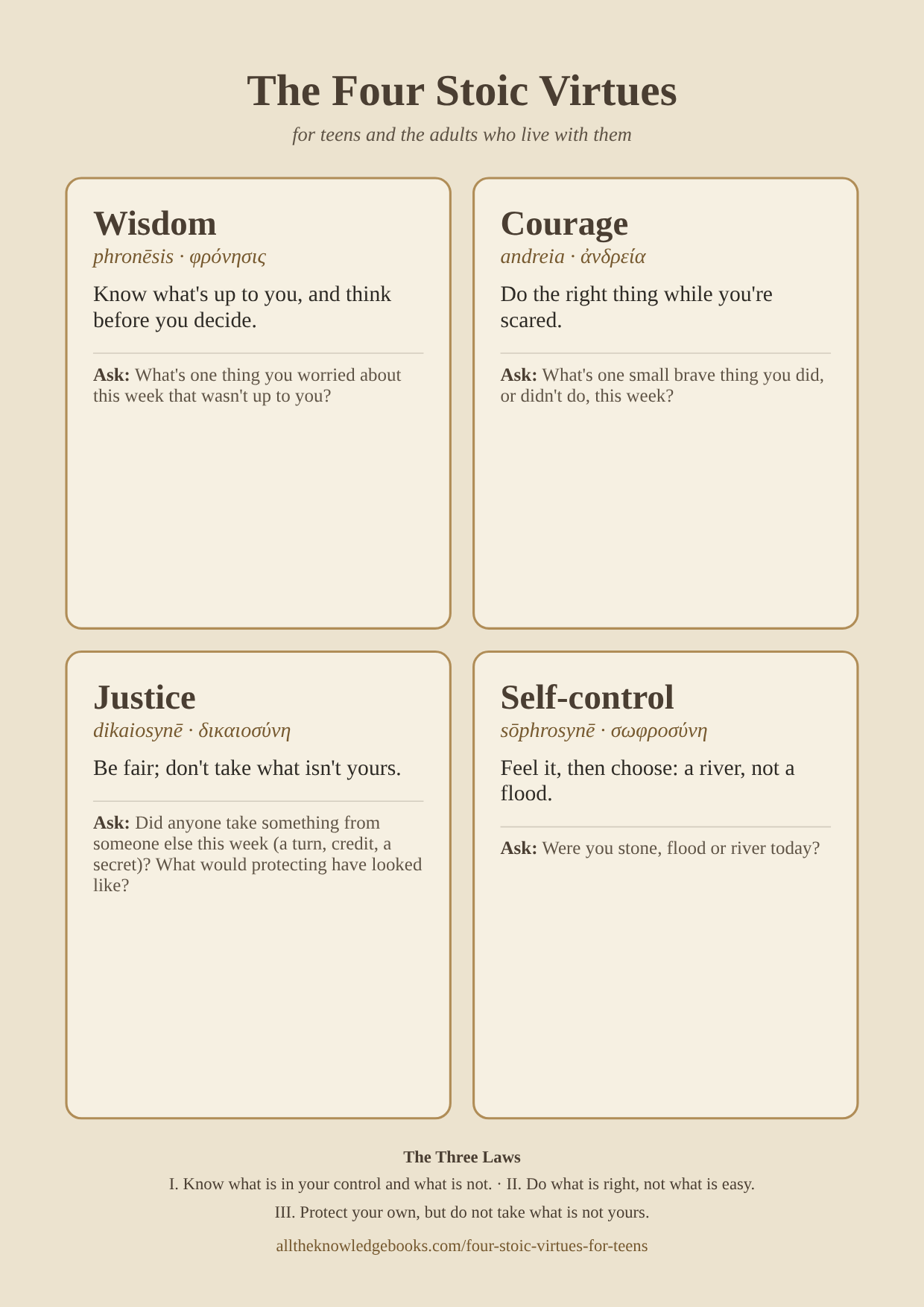
One A4 page: four boxes (virtue, Greek word, one line, one question) with the Three Laws at the bottom. Free, no email needed.
Want more?
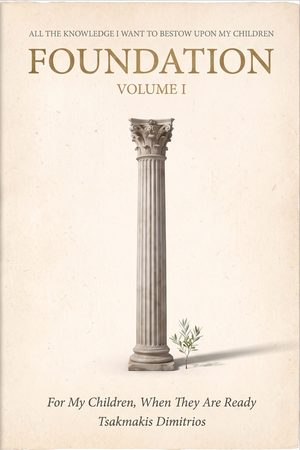
Foundation (Volume I)
Teaches the Three Laws. Chapters 3 to 8 end with three short exercises and chapters 9 to 13 with four.
Paperback $16.49 · ebook $5.99
Paperback on Lulu · PDF · EPUB
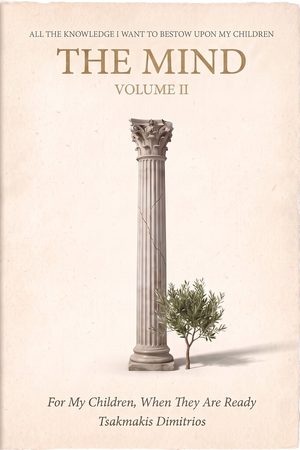
The Mind (Volume II)
Practice sections on clear thinking, logic, rhetoric and propaganda.
Paperback $18.49 · ebook $6.99
Paperback on Lulu · PDF · EPUB
Both are out in paperback and ebook (PDF and EPUB) via Lulu. See the full series, or, for another guide, write a letter to your teen.
Για αναγνώστες από την Ελλάδα: το βιβλίο είναι στα αγγλικά, με σύντομα, άμεσα κεφάλαια και αληθινές ιστορίες. Για κορίτσια και αγόρια από 12 ετών που διαβάζουν αγγλικά και για τους γονείς τους. Η ελληνική σειρά θα ακολουθήσει, αφού κυκλοφορήσουν και οι πέντε αγγλικοί τόμοι.
Dimitrios Tsakmakis served as a special forces paratrooper in the army and is now a serving police officer in Greece, with seven years in the counter-terrorism unit and time as a tactical instructor in other special units. He wrote All the Knowledge I Want to Bestow Upon My Children as a letter to the children he hopes to have.
Questions parents and teachers ask
What are the 4 virtues of Stoicism?
The four Stoic virtues are wisdom, courage, justice and self-control (often called temperance). Wisdom is judging what to do and what is up to you; courage is doing right while afraid; justice is fairness and not taking what isn't yours; self-control is governing what you feel and want. Plato named them; the Stoics made them the core of a good life.
Why are they called the cardinal virtues?
Cardinal comes from the Latin cardo, meaning hinge: the other virtues were said to hinge on these four. Plato named the four in the Republic, and the Stoics adopted them as their main virtues.
How do I explain the Stoic virtues to a teenager?
Take one virtue a week. Give one real example from school, sport or the phone, ask one question at dinner, and answer it yourself first. Short and honest works better than a lecture, and doing the practice yourself matters more than explaining it.
What's the difference between temperance and self-control?
They translate the same Greek word, sōphrosynē. Temperance is the older English word. Foundation prefers self-control and soundness of mind, and says sōphrosynē is not suppression but direction.
Are the four virtues religious?
No. They come from Greek philosophy, from Plato and the Stoics. This page uses them as a practical code for everyday choices at school, in sport and online.
What age is this for?
It is written for 12–16-year-olds reading with a parent, daughters and sons alike. That matches the 12+ guidance for the books.
Can teachers use this for Stoic Week?
Yes, as a one-page explainer, together with the printable card. For a full classroom course, see Modern Stoicism's free Stoic Week for Schools.
How do the virtues connect to the Three Laws?
In our reading, Law I is where wisdom starts, Law II needs courage and self-control, and Law III is justice, held in balance by courage and self-control. The books teach the laws; the four virtues live inside them.