Why teenagers lie (it’s usually about cost, not character)
Most teenage lies are an attempt to avoid a cost: trouble, a lecture, disappointment, losing freedom, or simply to keep some privacy as they grow up. Charities and clinicians who write for parents — among them the American Academy of Child and Adolescent Psychiatry (Lying and Children) and Coram Family Lives — list these same reasons. The lie is a shortcut past a price they do not want to pay.
“Telling the truth is hard when a lie would be easier.”
That line from Foundation names the problem exactly. The lie is the easy path. Law II — “Do what is right, not what is easy” — is about choosing the hard right one. Your job as a parent is not to catch every lie. It is to change the price list at home, so that telling the truth stops being the expensive option.
Everything on this page is written for daughters and sons alike. The examples say “your teenager” and “they”.
When you catch a lie: the first five minutes
A few habits matter most. None of them is about winning an argument; they are about not teaching your teenager that lying works better than honesty.
- Stay calm and don’t set traps. Asking a question you already know the answer to just teaches them to lie better. Children’s Hospital Colorado and PBS both warn against “gotcha” moments for the same reason.
- Say plainly what you know and that you’d rather hear the truth: “That doesn’t add up to me. Help me understand.”
- Separate the lie from the thing it hid. Deal with each, the lie first, briefly.
- Talk properly later, when you’re both calm — the same rule as for teen anger.
What not to do
- Don’t call them “a liar”. Label the act, not the person.
- Don’t punish the truth harder than the lie.
- Don’t lecture for twenty minutes.
- Don’t lie to them yourself, including the small social lies they can hear you tell.
Make the truth the easy option at home
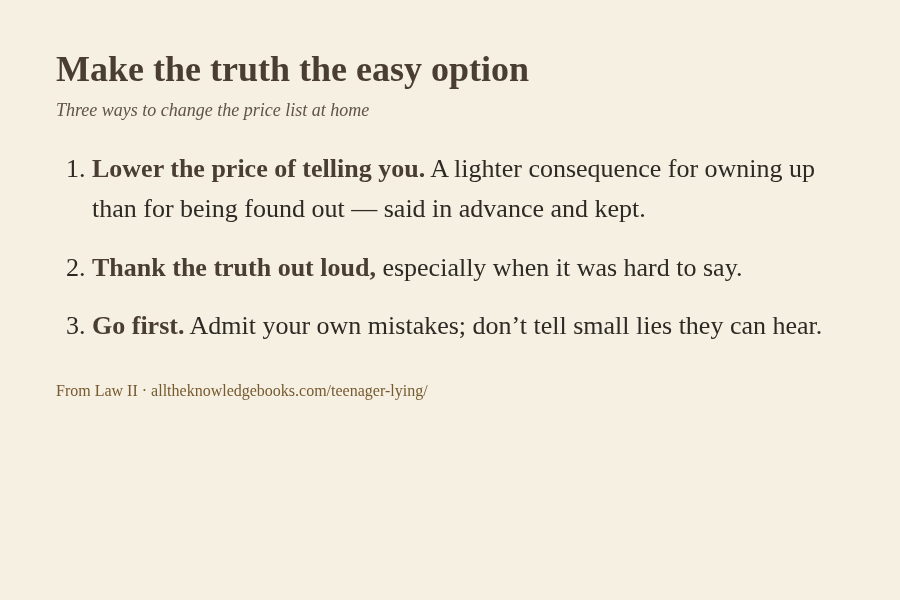
This is the heart of the page. Turn Law II around: if lying is the easy path, make the truth easier.
- Lower the price of telling you. A lighter consequence for owning up than for being found out, said in advance and kept. HealthyChildren.org puts it plainly: “You will get in much less trouble if you tell the truth instead of lying.”
- Thank the truth out loud, especially when it was hard to say. Notice honesty without turning it into a performance.
- Go first. Admit your own mistakes. In Foundation, Chapter 2’s “My Failures” section, the author lists how he failed each law — the point is the example, not the stories.
- Privacy is not lying. Teenagers are allowed some things that are theirs. Agree which things are non-negotiable to know (where, with whom, how they’re getting home) and which aren’t. AACAP notes that teens may lie to feel separate and independent.
- Repair, not shame. Give them a way back to trust that they can see: what they need to do, and for how long.
When your teenager lies about where they are
This lie matters most because you can’t help if you don’t know where they are.
- Agree a no-questions-first “come and get me” rule. They can call from anywhere, any time, and the pickup comes before the conversation.
- Agree the basics in advance: where, who, how home, check-in time — with a lighter consequence for “I’m somewhere I shouldn’t be, come get me” than for being found out.
- Location apps: if you use them, agree it openly. Secret tracking tends to teach secrecy back. No product names, no endorsement either way.
If whereabouts lies come with signs of drugs or alcohol, contact with much older people, money or items appearing, or staying out all night, move to When lying is a sign of something more serious. AACAP lists repeated lying about where they’ve been and who with as one way a serious problem can be hidden.
Law II: “Do what is right, not what is easy”
The second of the Three Laws is the honesty law:
II. Do what is right, not what is easy.
The easy path is usually a debt you pay later, with interest.
“Do not ask: ‘Does this feel good now?’ Feelings lie. Ask instead: ‘Will this make my future easier or harder?’”
In Foundation, Chapter 2, lying is named as the example of the easy path: “If a choice makes your future harder — skipping practice, spending all your money, lying to avoid trouble — it is the easy path with hidden interest.” Honesty is the hard path that becomes smooth. Hesiod put the same idea this way in Works and Days: “The road to virtue is long and steep, but at the top it is smooth.”
One more line linking Law I: the conversation goes better if the parent isn’t angry about what they can’t control. See keeping your own temper first.
Practise honesty together (from Foundation)
You can do these alongside your teenager. They are habits, not treatment. Each is named as it appears in the book:
- Law 2 exercise (end of Chapter 2, “What I Want You to Do”): pick one easy thing that makes your future harder — for example, “Lying to avoid a small chore” — and for one day do the harder right thing. Notice how you feel after.
- the Mean Game (Chapter 3, “What Is Good?”, “Three Exercises”): pick one virtue for one day; the book names honesty as one option.
- the Friendship Audit (Chapter 6, “Choosing Your People”, “Three Exercises”): which friendships make you more honest? Pair it with Chapter 6’s warning sign “Four: Secrets that compromise you” — a friend who asks you to lie for them:
“Four: Secrets that compromise you. They ask you to hide things, to lie for them, to do things you know are wrong and keep quiet. A real friend does not ask you to become smaller for their comfort.”
Honesty also sits under justice and courage in the four Stoic virtues for teens. For the full chapter, see Foundation, Chapter 2: The Three Laws.
When lying is a sign of something more serious
Talk to someone outside the family if you see:
- lying that is constant, elaborate, or doesn’t stop when the cost of the truth is lowered;
- lying that covers risky behaviour: drugs or alcohol, staying out all night, unexplained money or things, secret contact with much older people or strangers online;
- lying together with stealing, aggression, falling school results, or big changes in mood, sleep or friends;
- any sign of self-harm, or talk of it. Get help urgently.
Start with your family doctor or paediatrician, or the school, who can refer on.
In Greece
- 112: the European emergency number, works in Greece and every EU country. Use it if your teen may be in danger now or is missing.
- 10306: the national mental health line, 10306.gr. Free, anonymous, 24 hours.
- 1056: the National Helpline for Children SOS 1056, run by The Smile of the Child (Το Χαμόγελο του Παιδιού).
Useful reading (official and charity)
- AACAP: Lying and Children
- Coram Family Lives: What to do if your teen is lying to you or stealing
- HealthyChildren.org: When Children Lie
- Child Mind Institute: When should you get help for a child who’s a pathological liar?
- Greater Good Science Center (Berkeley): Three steps to teach children about honesty
This page shares one author’s experience and the Stoic tradition. It isn’t medical or psychological advice. We are not affiliated with any of the organisations above.
Questions parents ask
Why is my teenager lying to me all the time?
Usually because lying looks easier than the truth: it avoids trouble, a lecture, your disappointment or a lost privilege, and it keeps some privacy. Ask what telling you would have cost them, and lower that cost. If the lying is constant, elaborate or hides risky behaviour, talk to your doctor or the school.
What should I do when I catch my teenager lying?
Stay calm and say what you know, without setting traps: “That doesn’t add up. Help me understand.” Deal with the lie briefly, then with what it hid. Talk properly later, when you’re both calm. Make sure the consequence for telling the truth is lighter than the consequence for being found out.
My teenager lies about where they are. What should I do?
Agree the basics in advance: where, with whom, how they’re getting home and when they’ll check in. Offer a “call me from anywhere and I’ll come” rule, with the pickup before the questions. If they may be in danger or you can’t find them, call 112 in Greece and the EU.
How do I teach a teenager honesty?
Go first: admit your own mistakes and don’t tell small lies in front of them. Notice and thank the truth when it costs them something. Give honesty a rule they can remember. In Dimitrios Tsakmakis’s Foundation it is Law II, “Do what is right, not what is easy”, because telling the truth is hard when a lie would be easier.
When is a teenager's lying a sign of something serious?
When it is constant or elaborate, when it covers drugs, alcohol, staying out all night, money or contact with much older people, or when it comes with stealing, aggression or big changes in mood, sleep or school. Start with your doctor or the school. In Greece, 10306 is free, anonymous and open 24 hours; in an emergency call 112.
Is this book a parenting manual or therapy?
No. All the Knowledge I Want to Bestow Upon My Children is a series of books written as a letter to the children the author hopes to have, built on Three Laws and true stories. It isn’t therapy or medical advice; for persistent problems, talk to a professional.
The chapter behind this page

Foundation (Volume I)
Chapter 2, “The Three Laws”, sets out Law II and the honesty exercises above. The series is written as a letter to the children he hopes to have.
See the full series, questions about the books, or the companion guide: teen anger and Law I.
Για αναγνώστες από την Ελλάδα: το βιβλίο είναι στα αγγλικά, με σύντομα, άμεσα κεφάλαια και αληθινές ιστορίες. Για κορίτσια και αγόρια από 12 ετών που διαβάζουν αγγλικά και για τους γονείς τους. Η ελληνική σειρά θα ακολουθήσει, αφού κυκλοφορήσουν και οι πέντε αγγλικοί τόμοι.
Dimitrios Tsakmakis is a carpenter’s son from Athens. After school he served in the army as a special forces paratrooper, and since 2008 he has served in the Hellenic Police, including seven years in its counter-terrorism unit and work as a tactical instructor. He writes these volumes as letters to the children he hopes to have, after his father’s dementia showed him how completely what a person knows can disappear.